Roof, Gutter and Downspout Cleaning by Season in the Portland Area
Fir needles in fall, moss all winter, storms in between. A season-by-season look at keeping roofs and drainage working on community properties.
October 17, 2026 · 4 min read
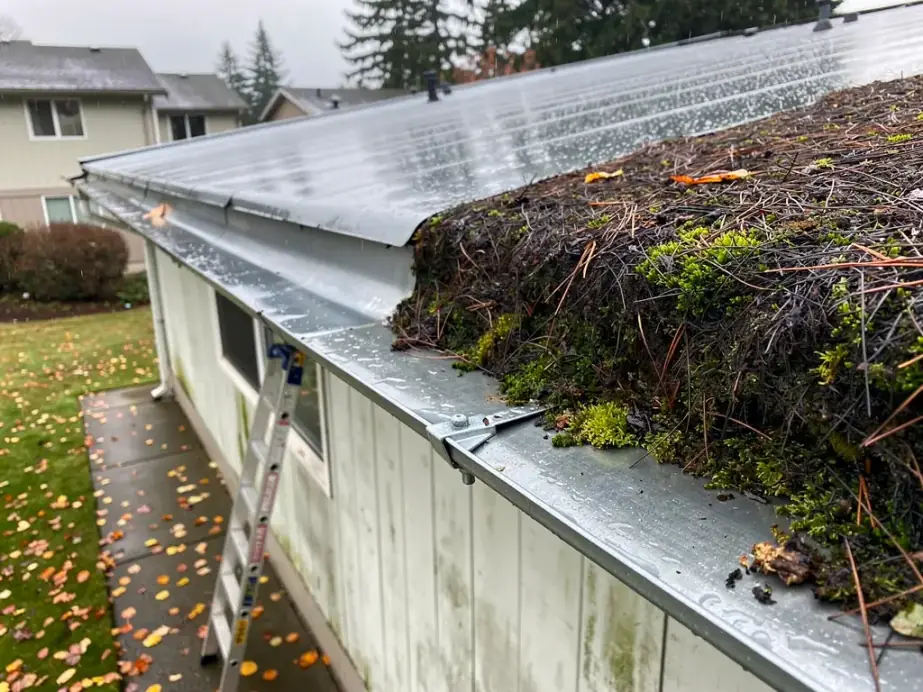
Roofs and gutters in the Portland and Willamette Valley area work harder than they do in drier parts of the country. Rain falls for months, evergreens shed year-round, and moss finds any surface that stays damp. A roof system can look fine from the parking lot while its drainage is quietly failing.
The usual advice is to clean gutters twice a year. That is a reasonable starting point, but the right timing depends on what is growing around your buildings. A community surrounded by Douglas fir has a different calendar than one with a few ornamental maples. The useful approach is to tie the work to the seasons your trees actually create.
What collects on a Northwest roof
Fir needles are small and stiff, and they pack tightly into gutters and onto the valleys of a roof. They don't break down quickly, so they build up layer on layer. Autumn leaves from deciduous trees arrive in a rush, usually within a few weeks, and wet leaves mat into a heavy mass. Moss grows on shaded roof planes and holds moisture against roofing material.
Add windblown debris, seed pods and the grit that sheds from aging roofing, and gutters can fill faster than residents notice. A gutter that holds debris also holds water, and water that sits can overflow, back up under roof edges, or add weight to fasteners that were never meant to carry it.
Spring: roof, gutter and downspout cleaning
Spring is the anchor of the maintenance calendar. After a winter of storms, roofs and gutters have collected months of debris, and clearing them before the weather dries out gives the buildings a fresh start. On the account executive's seasonal calendar, roof, gutter and downspout cleaning sits in spring alongside pressure washing and parking lot maintenance.
A spring visit is also the time to see what winter did. Technicians working at roof edges and along eaves can spot loose gutter hangers, separated seams, dislodged downspouts, and moss that has spread across a roof plane. Those observations feed into a repair list instead of surprising anyone next November.
Summer: a quiet window for planning
Dry weather is the easiest time to schedule repairs that come out of the spring review. Downspout replacements, gutter reattachment, and sealing at roof edges are simpler to do when surfaces are dry and the crews aren't racing storms. It's also a good time for a manager to ask the account executive about the fall plan, since the next heavy debris load is only a few months away.
Fall: before the rain settles in
Fall timing needs care. If the cleaning happens too early, a late leaf drop can refill the gutters. If it happens too late, the first heavy storms arrive on blocked drainage. Many managers schedule the fall pass after most of the leaves have come down and before the winter storm pattern sets in. On communities with large evergreens, a second light pass during winter can make sense.
Downspouts deserve as much attention as gutters. A downspout that is clogged at the bottom backs water up into the gutter, and one that discharges against a foundation sends moisture straight toward the building. Checking the outlets and where the water goes once it leaves the pipe is part of a thorough job.
- Gutters: clear of needles, leaves and plant growth, with seams and hangers checked.
- Downspouts: flowing freely from the top to the outlet, and discharging away from walls.
- Roof surfaces: moss and debris removed where it holds moisture, and valleys left open.
- Roof edges: staining or soft trim noted and photographed for follow-up.
Winter storms and winterization
Winter work is mostly responsive. A windstorm can drop branches across a roof, and a heavy rain can show weak spots instantly. Winterization, which appears on the seasonal calendar alongside the spring items, is what reduces the number of surprises. It covers preparing drainage, checking exposed areas and getting a property ready for the worst weather before it arrives.
When something does go wrong, requests by email, phone or web form become job tickets, and the account executive coordinates the response. Technicians submit photos of the condition and the repair, and the account executive emails the status with photo documentation.
Putting it on the calendar
The simplest way to manage this work is to stop treating it as a series of separate calls. HOA Services builds an annual seasonal calendar through the account executive assigned to your community, with spring and fall roof, gutter and downspout cleaning placed where your trees and buildings call for them. Crews can be pre-scheduled for the busy seasons, so you aren't competing for an opening the week after a storm.
The technicians work with an eyes-up mindset, which means they look at what is above and around the job as well as the task in front of them. A gutter visit that also catches a lifting shingle or a failing downspout bracket is worth more than the cleaning alone.
To set up a seasonal plan for your community, call (503) 620-8386. The proposal is free, and the account executive can set up a site visit.
HOA Maintenance Services, (503) 620-8386
Call (503) 620-8386More articles
Why a Documented Property Walk Beats Reactive Repair Calls
The Maintenance Shield Program replaces scattered emergency calls with one documented walk, one report and one vendor.
Where Water Gets Into Multifamily Buildings in a Wet Northwest Winter
Caulk seams, decks, gutters, crawl spaces, attics and siding: where moisture finds a way in, and how a leak investigation is run from the first report.