Where Water Gets Into Multifamily Buildings in a Wet Northwest Winter
Caulk seams, decks, gutters, crawl spaces, attics and siding: where moisture finds a way in, and how a leak investigation is run from the first report.
October 17, 2026 · 4 min read
Rain in the Portland area is rarely dramatic. It is steady, it arrives for months, and it works at a building slowly. That is what makes water intrusion expensive: by the time a resident reports a stain, the water has often been traveling for a while, through framing and insulation, before it showed up on a ceiling or wall.
Property managers and board members don't need to be building scientists, but knowing the usual entry points helps. Most leaks in multi-unit buildings come from a short list of places, and almost all of them can be spotted early by someone looking with the right mindset.
Caulk seams and building envelope joints
Sealant joints around windows, doors, trim boards, penetrations and siding transitions are the first line of defense, and they age. Sun, temperature swings and years of wetting and drying make caulk shrink, crack and pull away from the surface it was bonded to. A hairline gap doesn't look like much, but wind-driven rain will push water into it.
Look for joints that have split, sealant that has gone chalky or hard, and gaps where two different materials meet, such as trim and masonry. Resealing a failed joint is one of the cheapest repairs on a building, and one of the most commonly postponed.
Decks, balconies and stairs
Horizontal surfaces collect water, and wood that stays wet rots. Deck boards, ledger connections, stair stringers and railing posts all take a beating in a wet winter. Water that gets under a deck surface can reach the framing where nobody can see it. Soft spots underfoot, discoloration around fasteners, and rails that flex are signs the structure needs a closer look.
Moss and algae on stair treads add a second problem, because they make surfaces slippery as well as damp. Washing and inspection together tell you whether the issue is surface growth or something deeper in the wood.
Gutters, downspouts and roof edges
Fir needles, leaves and moss clog gutters faster than most people expect. When a gutter overflows, water runs down the siding and collects at the base of the wall, or it backs up under the roof edge. A downspout that empties right at a foundation sends water exactly where you least want it. Many leak complaints trace back to drainage that stopped draining.
- Gutters holding standing water or sprouting plant growth.
- Downspouts that are loose, disconnected or discharging against a wall.
- Staining on siding below a roof edge, which usually means overflow.
- Soil or landscaping that slopes toward the building instead of away.
Crawl spaces and attics
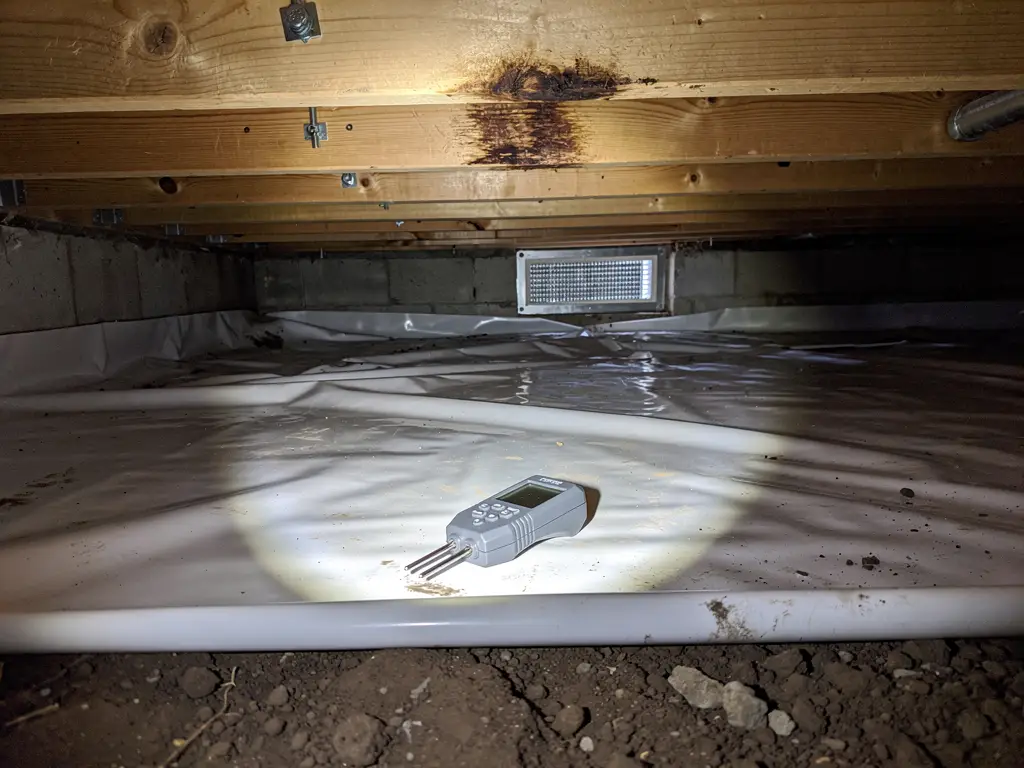
Crawl spaces and attics are where moisture problems hide. In a crawl space, damp soil, a failed vapor barrier or a plumbing drip can raise humidity under the whole building, feeding mold and wood decay. In an attic, a roof leak or poor ventilation can dampen insulation and sheathing for months before anything shows up in a unit.
Both spaces reward a periodic visit with a flashlight, a moisture meter and a camera. Nothing replaces a person actually looking at the framing, the insulation and the underside of the roof deck.
Siding and exterior surfaces
Siding sheds water only while it is intact and properly lapped. Cracked boards, gaps at corners, damaged trim and failed paint all give water a path behind the surface. Wood siding that stays wet develops rot, and the damage may be well underway before the paint bubbles. A walk around the building after a hard rain, looking up and along the walls, is one of the simplest inspections a manager can do.
How a leak investigation runs
When a resident reports a leak, the request can arrive by email, phone or web form. HOA Services turns it into a job ticket. The account executive assigned to your community gathers the details, including unit location, a phone number and any photos, and may send a technician out to assess before any repair is scheduled.
The goal is to trace the water back toward its source rather than treat the stain. That can mean checking the roof edge, the gutters, the siding above the unit, the deck or balcony, and the attic or crawl space below or above. Findings are photographed. The account executive then coordinates access and schedule, and resident notices can be distributed in advance when a unit or common area will be affected.
Once the source is found, the technician repairs it where possible, cleans up and removes debris. Water intrusion and leak investigation, rot repair, attic and crawl space remediation, and exterior building repairs are all handled in the same repairs division, so the person who finds the problem isn't handing it to a different company. Afterward the technician submits before, during and after photos, and the account executive emails a status update with that photo documentation.
If your community has leaks you can't explain, or you want a second set of eyes before winter, call HOA Services at (503) 620-8386. Proposals are free.
HOA Maintenance Services, (503) 620-8386
Call (503) 620-8386More articles
Why a Documented Property Walk Beats Reactive Repair Calls
The Maintenance Shield Program replaces scattered emergency calls with one documented walk, one report and one vendor.
Dryer Vent Cleaning on Multifamily Buildings: Method, Schedule and Notices
Lint builds up where residents can't see it. Here is how exterior dryer vent cleaning works on a multi-unit building and how to schedule it without chaos.