Repairs · Masonry
Concrete Masonry Services
Mortar repair, brick and stone replacement and full masonry restoration for multifamily and commercial buildings around Portland and the Willamette Valley.
What cracked mortar and spalled brick are telling the board
Masonry is built to last, and in the Pacific Northwest it is tested by water more than by load. Brick and block take on moisture, cool, dry and take it on again for decades. The warning signs are familiar: crumbling or recessed mortar, chipped or cracked brick, white mineral bloom called efflorescence, and discoloration that tracks a downspout.
Cracks come in two kinds, and the difference matters. Hairline cracks from seasonal shifting and expansion are common and often cosmetic. Cracks in a masonry foundation are another matter because they can affect the structure, and those should be looked at promptly. A technician on site can tell the two apart, and photos let the account executive show the board which is which.
Neglected mortar joints let water behind the face of the wall, where it is harder to see and costs more to fix. Landscaping that holds water against the base, a failed gutter that runs down one face, and a blocked drainage path all feed the same problem. Good repair starts by finding where the water is coming from.
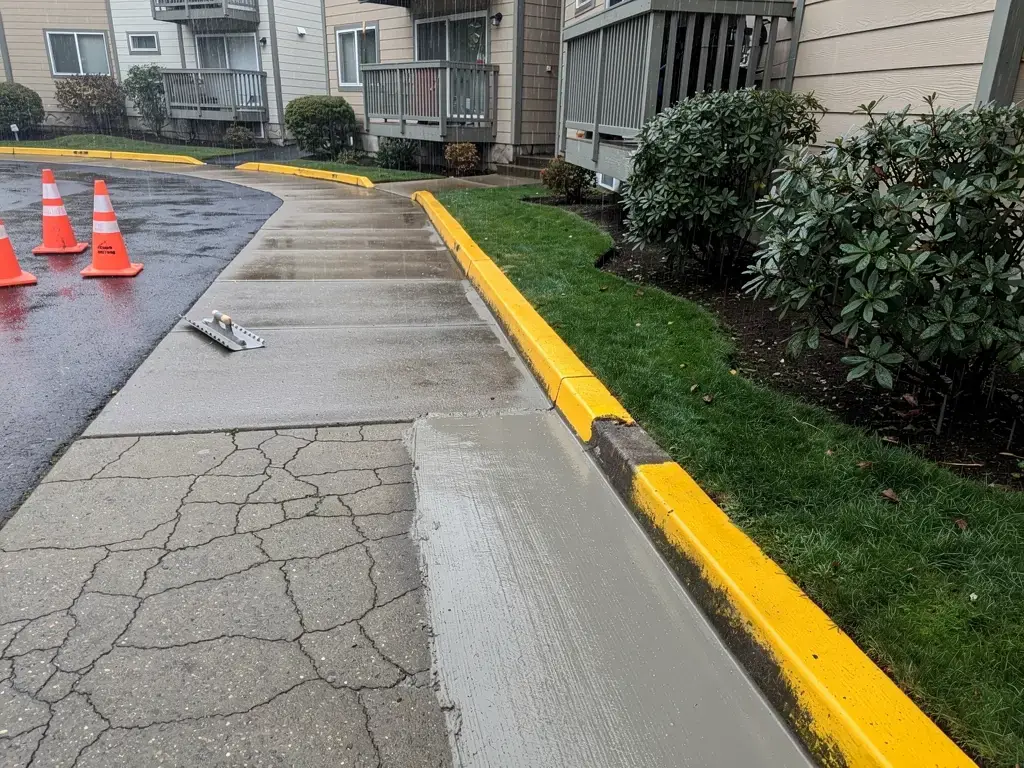
Illustrative image of an apartment walkway with a freshly patched concrete section beside cracked older slabs, cones, a trowel and a painted yellow curb
Remove, clean, wet, repoint, match
A masonry wall repair follows a set order. Old mortar is removed from the failed joints, debris is cleaned out, and the wall is dampened so it does not pull moisture out of the fresh mortar too fast. New mortar is mixed and packed in, cracked or failed bricks and stones are taken out and replaced, and the wall is brushed down to finish.
Matching is where a repair either disappears or announces itself. HOA Services matches tile and brick to what is on the building, and the mortar type is chosen for the application, since the common N, O, S and M mixes differ in strength, flexibility and bond. Damaged stone is patched or repaired in the same spirit, not covered over.
On the administrative side it runs like the rest of the repairs division. A work order becomes a job ticket, the account executive gathers details and may dispatch a technician to assess, then coordinates access and schedule. The technician repairs, cleans up, hauls off debris, and submits photos for the status email that comes back to you.
Restoration, repair, and the maintenance between them
A few bad joints call for repair. A wall where the mortar is going everywhere calls for restoration, which treats the masonry as a whole instead of patching it spot by spot. The assessment visit sorts out which one a property needs, and the proposal says so. Done in the right scope, restoration can carry a building for a long time.
Between repairs, the calendar does the work. Gutters and downspouts cleaned each spring keep water off the wall faces, pressure washing and siding cleaning remove the growth that holds moisture, and a technician with an "eyes up" habit will flag a failing joint on an unrelated visit. Each of those lands in the account executive's records.
Photo documentation builds a history of the building: what was there, what was removed, what went back. For commercial, multifamily and HOA properties across the Portland metro and the Willamette Valley, that history is what a manager points to when a board asks why a wall is being repaired now and not next year.
HOA Services: Oregon CCB 208889 · Washington CCB COMMUMS842JQ. Call (503) 620-8386.